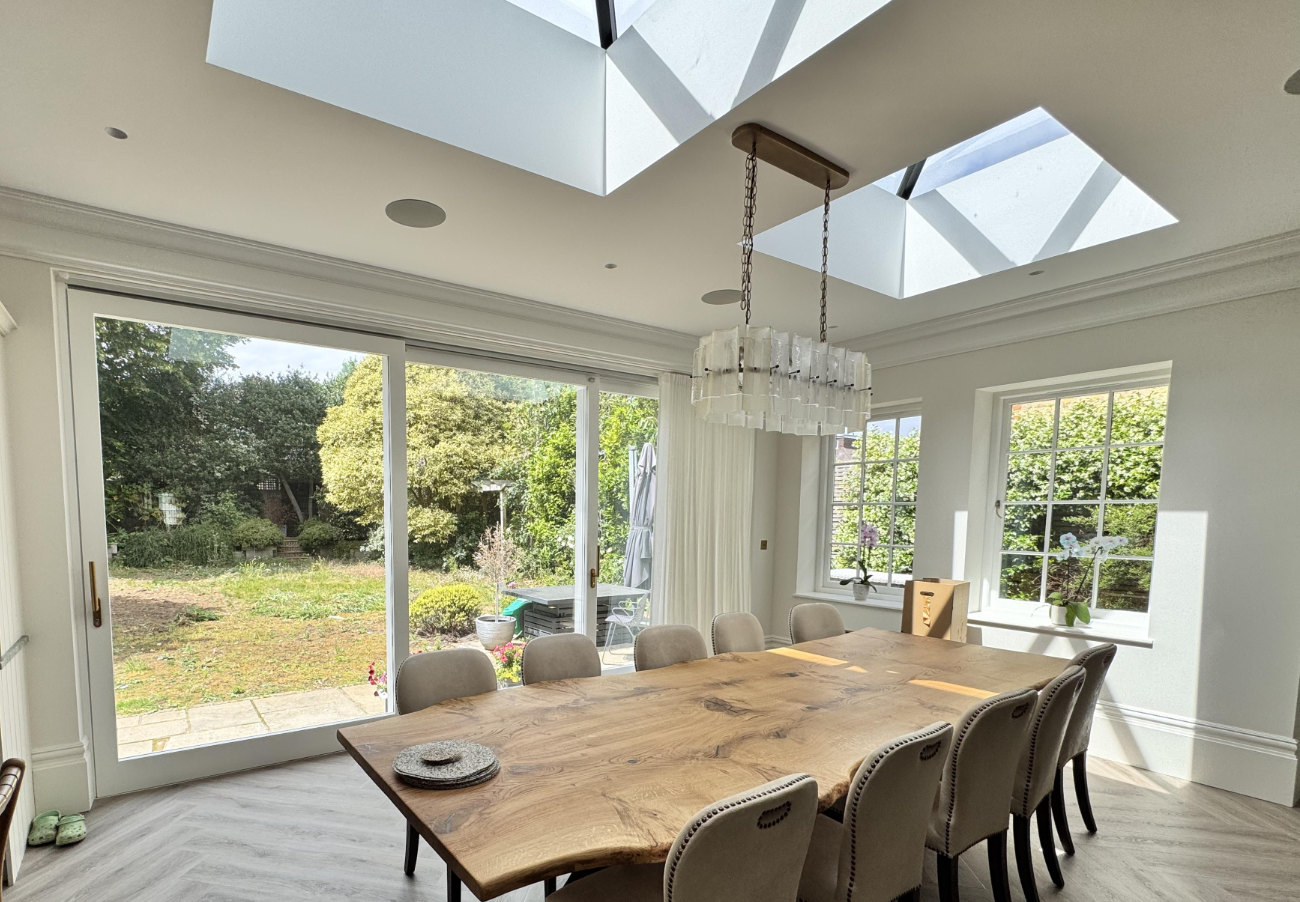

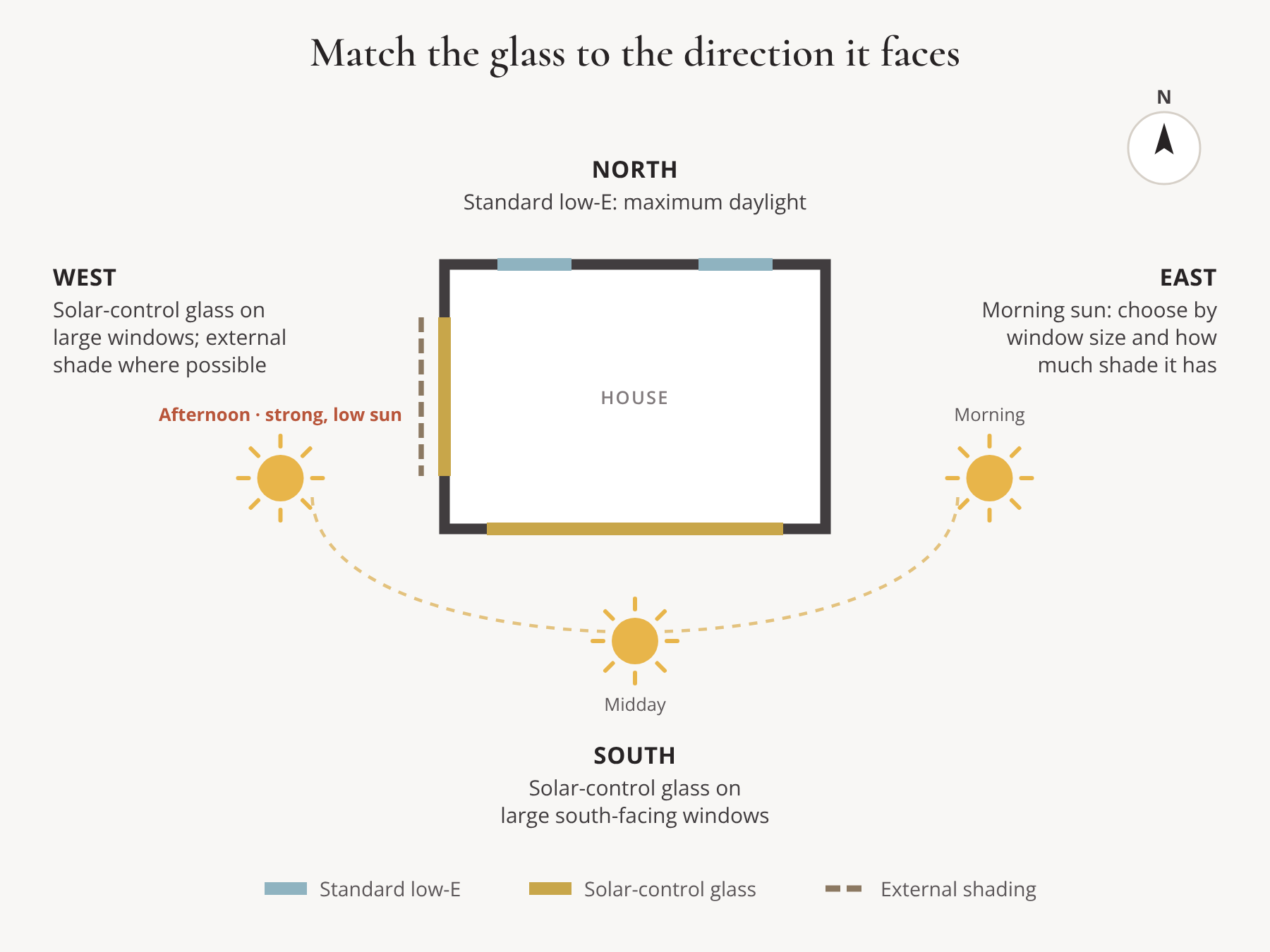
Overheating depends on the direction a room faces, the size of the windows, the amount of shade, ventilation, insulation and how the room is used. A large west-facing window can be particularly challenging because it receives strong, low-angle afternoon sun. Roof glazing and large areas of south-facing glass can also admit a great deal of heat. The best solution is therefore considered as a whole: control the sunlight before it reaches the glass where possible, provide effective ventilation, and specify the right glazing for the particular elevation and room.
Before looking at specialist glass, it is worth considering some straightforward design measures:
Glazing specifications contain plenty of figures, but two are especially useful:
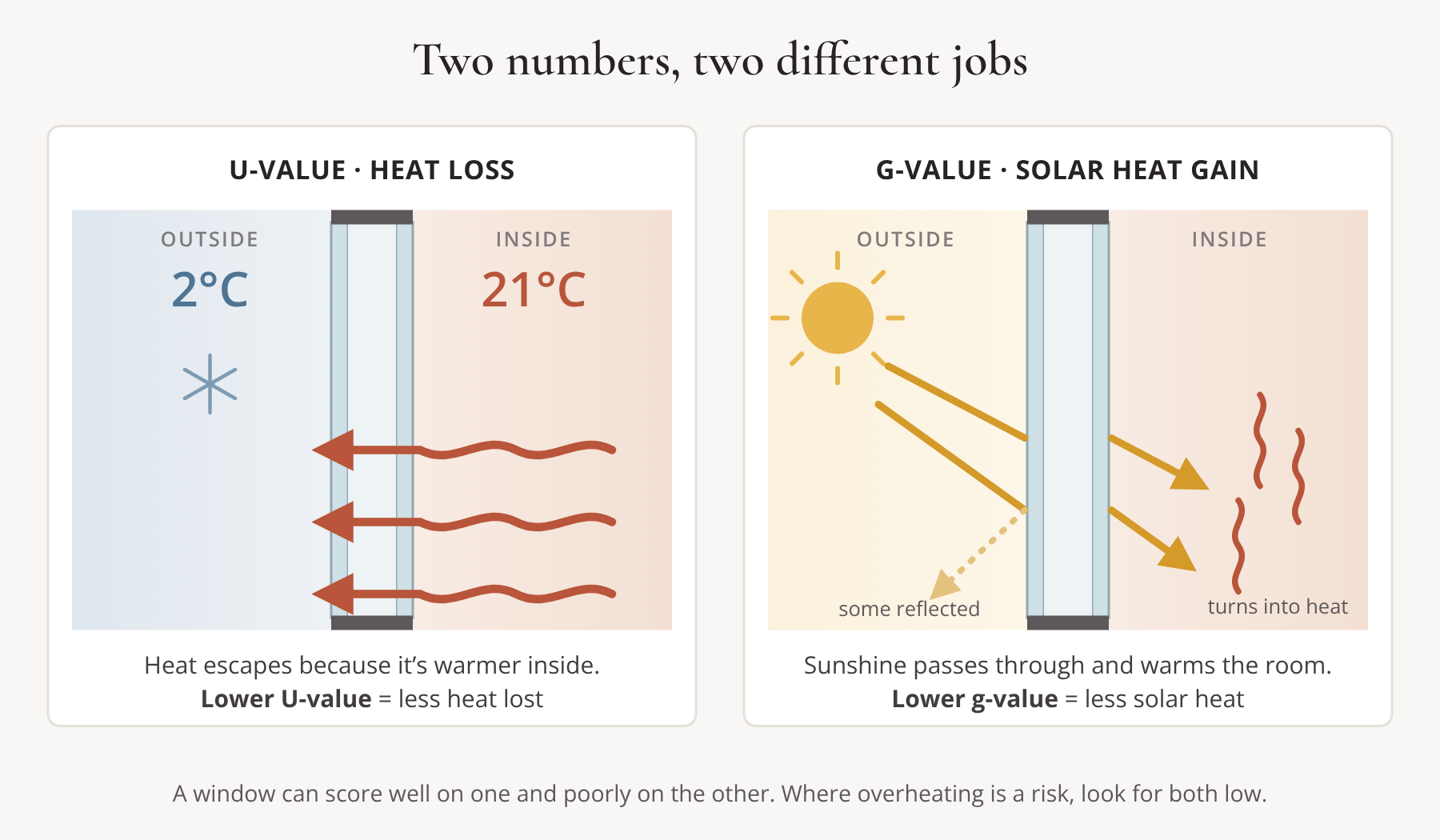
These figures describe different things. A window can be very well insulated, with a low U-value, but still admit substantial heat from direct sunshine.
Put the two together, however, and the result can be highly effective throughout the year. A unit combining a low U-value with a low g-value reduces heat loss in cold weather, slows heat transfer when the air outside is hotter, and limits the additional heat created by direct sunshine. In a room with a genuine overheating risk, that combination offers the strongest year-round protection.
Figures quoted below are centre-pane values for representative glass build-ups, not whole-window values. Actual performance depends on pane thicknesses, cavity width, gas fill, coatings, framing and other details, so every final specification should be checked for the particular project.
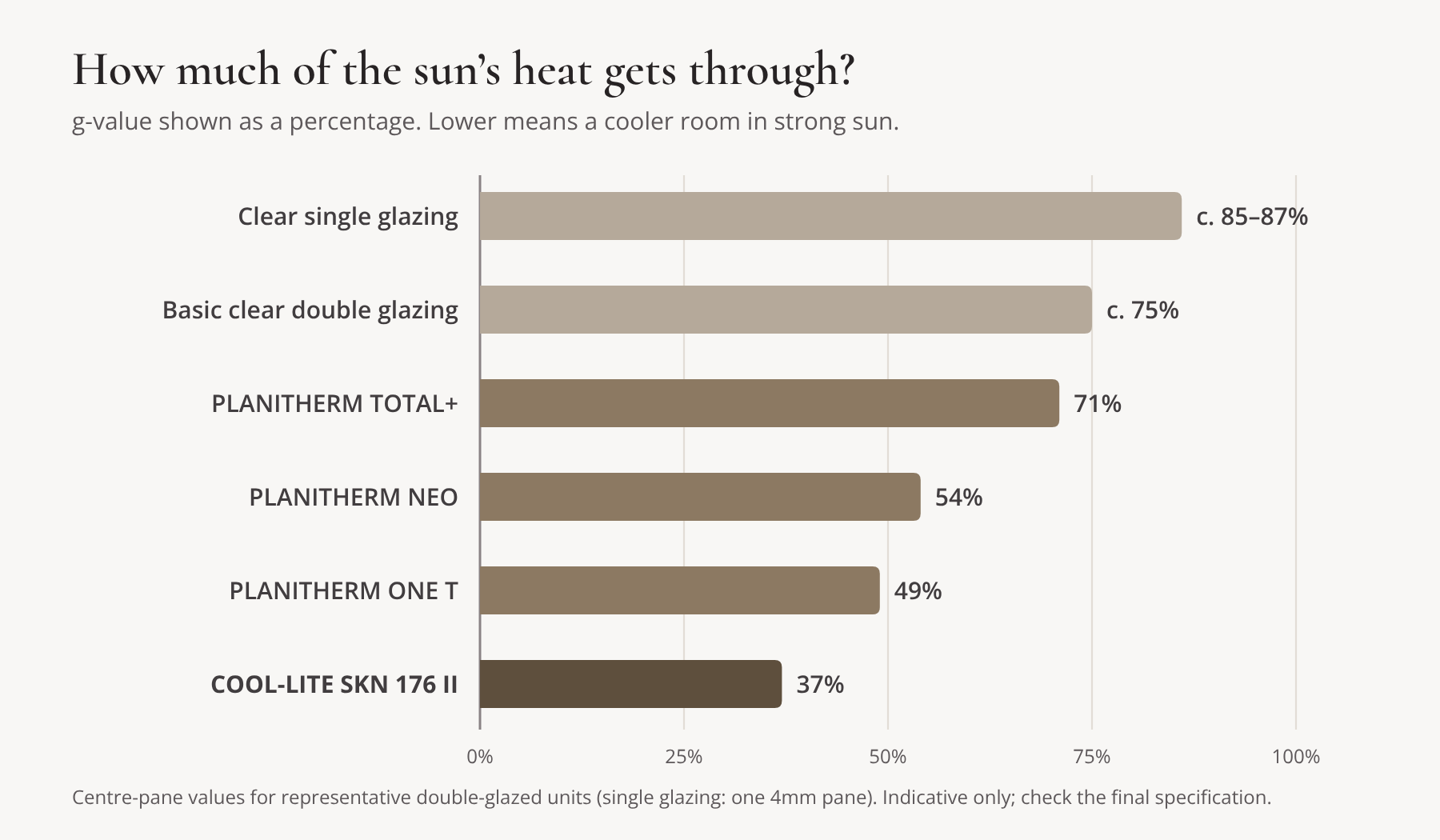
Clear single glass provides very little thermal insulation. A typical 4mm pane has a U-value around 5.8 W/m²K and admits roughly 85–87% of the sun’s energy. In bright sunshine, it offers almost no meaningful solar control; the room can behave rather like a greenhouse.
Adding a second clear pane and a sealed cavity greatly reduces heat transfer caused by the difference between indoor and outdoor temperatures. A conventional air-filled clear double-glazed unit may have a centre-pane U-value of around 2.7 W/m²K.
However, clear double glazing still admits a high proportion of solar energy, typically around three quarters. It is much better than single glazing for winter insulation, but the improvement in summer solar gain is comparatively modest.
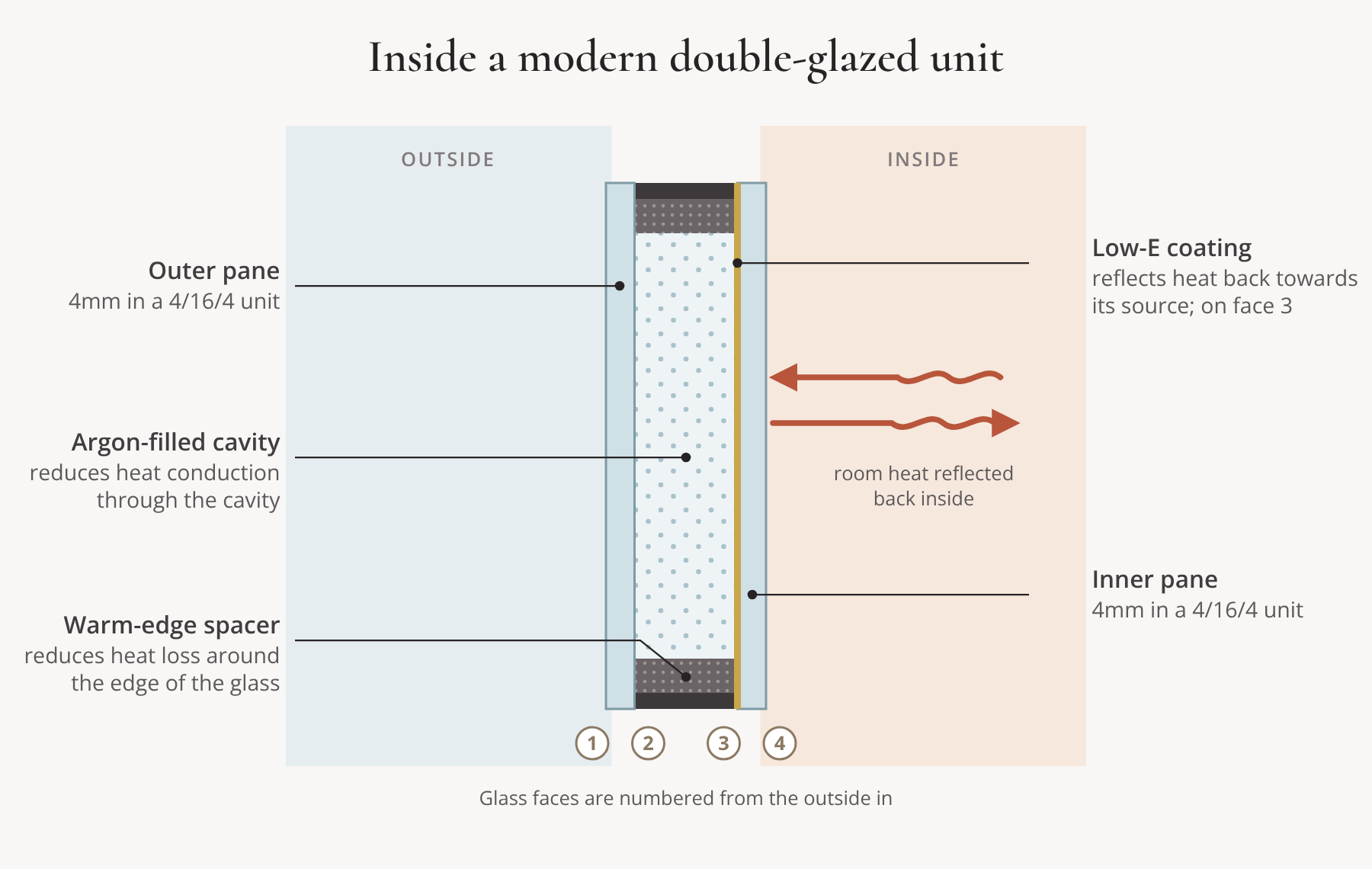
A good modern unit will normally include a warm-edge spacer, an argon-filled cavity and a low-emissivity coating such as PLANITHERM® TOTAL+.
Each element has a role:
In a representative 4mm/16mm/4mm unit with 90% argon, PLANITHERM TOTAL+ has a centre-pane U-value of 1.2 W/m²K, light transmission of 79% and a g-value of 0.71.
That is a major improvement in insulation over single glazing or basic double glazing, and it helps keep the inner surface warmer in winter. But its relatively high g-value is deliberate: standard low-E glass is designed to retain heat while still making use of free solar gain for good Window Energy Ratings. It will not, on its own, prevent a heavily glazed room from overheating in strong summer sun.
This is why the phrase “energy-efficient glass” needs a little care. Energy efficiency and summer comfort overlap, but they are not the same thing.
Solar-control glass becomes particularly useful where there are large glazed areas, roof glazing, limited external shade, or rooms facing strong afternoon sun. It reduces the proportion of solar energy entering the home while ideally retaining good daylight, winter insulation and a reasonably neutral appearance.
There is still a balance to consider. Stronger solar control can mean some combination of lower daylight transmission, more visible reflection, a change in colour or greater cost. A low g-value also reduces useful solar warmth in winter, although a low U-value will continue to limit heat loss through the glazing. The aim is therefore to choose the lowest appropriate g-value while preserving the daylight and appearance wanted for that particular window.
PARSOL® is a body-tinted float glass available in colours such as bronze, grey, green and blue, subject to local availability. The colour runs through the glass rather than being applied as an almost invisible modern coating.
For many years, tinted glass was one of the few straightforward ways to obtain basic solar control. It still has architectural uses, but for domestic windows its pronounced colour and reduced daylight can be difficult to accept. It may also be relatively expensive once the required processing and insulating unit specification are taken into account. Because tinted glass absorbs more heat, the need for toughening or other heat treatment must also be assessed.
PARSOL is therefore worth knowing about, but it is generally an aesthetic choice as much as a performance choice, rather than our first recommendation for discreet solar control in a traditional home.
PLANITHERM® 4S combined low-E insulation with solar control. A representative double-glazed specification had a U-value around 1.0 W/m²K, light transmission around 65–66% and a g-value of approximately 0.43.
It was once a familiar option for conservatories and other highly glazed rooms. It is now being phased out of the UK offering and should be regarded as obsolete for new UK specifications. The name still appears online because versions remain available in a small number of overseas markets, but availability should not be assumed. Current projects are better designed around a product with a secure future supply.
PLANITHERM® ONE T is primarily a high-performance low-E glass, but it also reduces solar gain more than standard PLANITHERM TOTAL+. In a representative argon-filled double-glazed unit it achieves a centre-pane U-value of 1.0 W/m²K, light transmission of 67% and a g-value of 0.49.
Saint-Gobain describes its appearance as neutral, so it should not be confused with a strongly coloured body-tinted glass such as PARSOL. Nevertheless, compared with standard clear low-E glazing it transmits less daylight and has higher internal and external reflectance, both stated as 25% in the published build-up. In practice, that can make it look darker or more reflective.
This is especially important where new windows must sit discreetly within a traditional façade, conservation area or listed building. Planning requirements vary, and no glass is universally accepted or rejected, but a sample and an early conversation with the conservation officer may be sensible before committing to a conspicuous glazing specification.
PLANITHERM® NEO is Saint-Gobain’s newer low-E product for double and triple glazing, launched for the UK market in 2026. Its emphasis is excellent insulation with a neutral appearance, low reflection and high light transmission.
In the manufacturer’s representative argon-filled double-glazed unit, it achieves a centre-pane U-value of 1.0 W/m²K and a g-value of 0.54. That admits less solar energy than PLANITHERM TOTAL+ at 0.71, while avoiding the stronger solar-control appearance associated with some older products.
NEO is therefore an attractive, balanced choice where homeowners want excellent insulation and a modest reduction in solar gain without making the glass look overtly tinted. It should not, however, be presented as the strongest year-round solution for a severe overheating problem. Where overheating is a genuine concern, a glass combining the same low U-value with a lower g-value will provide greater protection from summer solar gain while retaining comparable insulation in winter.
Another issue is supply. At the time of writing, PLANITHERM® NEO has limited distribution and is not carried by many glass or double-glazed unit suppliers.
COOL-LITE® SKN is a specialist high-performance solar-control range. Unlike body-tinted glass, it uses a selective coating designed to admit a high proportion of visible daylight while rejecting a much larger proportion of solar heat.
For example, the current COOL-LITE SKN 176 II data gives, for a representative 6mm/16mm/4mm argon-filled unit, a centre-pane U-value of 1.0 W/m²K, light transmission of 70% and a g-value of 0.37. In simple terms, it admits about 70% of visible light but only about 37% of the sun’s total energy. This relationship is described as “selectivity”, and it is where a modern solar-control coating can outperform a simple dark tint.
SKN can therefore be a strong candidate for large expanses of glass where overheating is a genuine design risk but good daylight and a relatively neutral appearance remain important. Its combination of a 1.0 W/m²K U-value and 0.37 g-value makes it effective throughout the year: it provides insulation comparable with the best low-E units while admitting considerably less solar heat. The qualification is that it also admits less free solar warmth in winter, but on a highly glazed or overheating-prone elevation, that may be a very worthwhile trade-off.
It is a premium, processed product and requires the correct pane, coating position, toughening and edge preparation. There are several SKN variants, so “SKN glass” is not a complete specification: the exact product and glazed-unit build-up must be chosen for the project.
| Glazing | U-value (W/m²K) | Light transmission | g-value |
|---|---|---|---|
| Clear single glazing (4mm) | c. 5.8 | — | c. 0.85–0.87 |
| Basic clear double glazing (air-filled) | c. 2.7 | — | c. 0.75 |
| PLANITHERM TOTAL+ | 1.2 | 79% | 0.71 |
| PLANITHERM ONE T | 1.0 | 67% | 0.49 |
| PLANITHERM NEO | 1.0 | — | 0.54 |
| COOL-LITE SKN 176 II | 1.0 | 70% | 0.37 |
The build-ups are not identical and the first two rows are typical indicative values. The table is useful for understanding scale, not as a final specification or quotation.
For an ordinary window with modest summer exposure, a well-made argon-filled, warm-edge low-E unit may remain the right choice. It offers excellent winter comfort and a clear, neutral appearance at a sensible cost.
Where there is some overheating risk but appearance is particularly sensitive, PLANITHERM NEO may offer a useful middle ground. Where solar gain is a serious concern, especially with large panes, roof glazing or west-facing elevations, a selective product such as COOL-LITE SKN provides the stronger year-round performance: a similarly low U-value for insulation, combined with a substantially lower g-value for solar control. Its additional cost, appearance and reduced winter solar gain still need to be weighed against the severity of the overheating problem.
PARSOL and older products such as PLANITHERM 4S form part of the story of solar-control glazing, but newer selective coatings give us more sophisticated choices than simply making the glass darker.
The most successful solution is often mixed rather than uniform: ordinary low-E glass on cooler elevations, solar-control glass where the sun is most problematic, and external shade or planting where the design allows it. That approach controls heat without unnecessarily reducing daylight throughout the whole house.
If you are planning new windows and are concerned about overheating, speak to us early. We can look at the orientation, glass area, room use, appearance and planning context, then discuss a glazing specification that balances summer comfort, winter warmth, daylight and the character of the building.
This article focuses primarily on glass types available from Saint-Gobain. Other suppliers such as Pilkington, Guardian and AGC offer their own solar-control glass under their own brand names.
Product figures are representative centre-pane values from manufacturer-published configurations and should be reconfirmed at quotation stage.
The statement about PLANITHERM 4S is UK-specific. Saint-Gobain’s current global page lists availability in Spain and Romania, so “obsolete” should not be interpreted as discontinued worldwide.





2026 Woodland of Kingston Ltd
Woodland of Kingston, St Peters House, 6 Cambridge Rd, Kingston upon Thames KT1 3JY
Registered in England No: 3833894 VAT No: 217 3996 39
Website Design by Nadja


